Service Hotline:86-17346269651 /

From January to April 2026, China’s exports of construction machinery to Africa continued to grow, with excavator export value increasing by 54% year-on-year. South Africa, Nigeria, and Guinea remained among the leading destination markets, reinforcing Africa’s position as a key incremental growth region for China’s construction equipment industry.
The growth has been driven largely by continued expansion in mining development activities. As mineral resource projects accelerate across multiple countries, demand for medium and large excavators in surface mining, ore handling, and loading operations continues to rise. Copper, gold, and lithium-related projects have become the core drivers of equipment demand growth.
At the same time, rising fuel consumption and increasing maintenance costs are placing greater pressure on mining operators. Against this backdrop, the industry’s demand for more energy-efficient and lower life-cycle cost powertrain solutions is strengthening, accelerating the transition toward electrified power systems in mining applications.
I. Why Can Electric Excavators Significantly Reduce Mining Operating Costs?
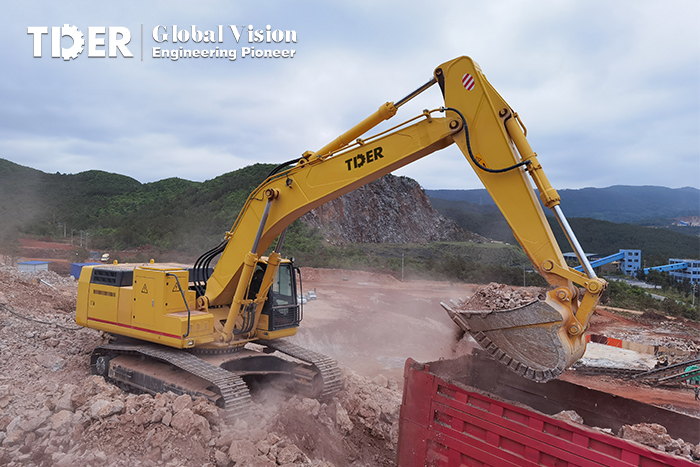
Against this trend, the TDER 21-ton electric excavator is increasingly being used as a benchmark case for cost comparison with conventional diesel-powered machines. Under identical working conditions, electric excavators can reduce total operating costs by approximately 68%–81%, driven primarily by two key factors: energy consumption and maintenance requirements.
1. Energy Consumption Comparison
Under equivalent operating intensity and standard duty cycles, diesel and electric excavators differ significantly in energy cost structure.
Diesel-powered machines rely primarily on fuel consumption as their main operating cost driver, while electric models are powered by grid electricity, resulting in substantially lower energy expenditure per unit of work.
Energy cost comparison (21-ton class excavators):
Item | Diesel Excavator | Electric Excavator |
Energy type | Diesel fuel | Electricity |
Consumption rate | 15–18 L/hour | 20–40 kWh/hour |
Energy price | ~USD 1.0/L | USD 0.07–0.14/kWh |
Operating cost per hour | USD 15–18 | USD 1.4–5.6 |
Cost difference | — | Savings of USD 9.4–16.6 per hour |
2. Maintenance Cost Comparison
Maintenance expenditure is a critical component of total life-cycle cost in mining operations.
Diesel-powered excavators require regular servicing of engine systems, including oil changes and replacement of oil filters, fuel filters, and air filters. These machines typically follow a maintenance cycle of approximately every 250 operating hours.
Electric excavators, by contrast, eliminate engine and fuel system components, significantly reducing routine maintenance requirements. Servicing is mainly limited to periodic lubrication of electric motor bearings, typically at around 2,000-hour intervals.
Maintenance cost comparison:
Item | Diesel Excavator | Electric Excavator |
Powertrain structure | Internal combustion engine | Electric motor drive |
Key maintenance items | Oil, oil filter, fuel filter, air filter replacements | Motor bearing lubrication |
Service interval | ~250 hours | ~2,000 hours |
Annual operating hours | ~3,000 hours | ~3,000 hours |
Maintenance frequency | ~12 times/year | ~1–2 times/year |
Cost per service | ~USD 285 | Minimal lubrication cost |
Annual maintenance cost | ~USD 3,600 | ≤ USD 500 |
3. Overall Cost Impact
Based on combined energy and maintenance cost analysis, electric excavators can reduce annual operating costs by more than USD 40,000 per unit under typical mining conditions.
This significant reduction shortens equipment payback cycles and further strengthens the economic case for electrification in high-intensity mining environments.
II. Electrified Solutions for Different Mining Conditions
As demand for electrification in mining becomes more defined, equipment manufacturers are accelerating the development of multi-path powertrain solutions to address differences in power supply conditions, operational intensity, and infrastructure across emerging mining regions, particularly in Africa.
TDER, for example, has developed a diversified electric excavator portfolio covering three main power architectures: tethered (cable-powered), battery-electric, and hybrid systems, designed to suit different mining environments.
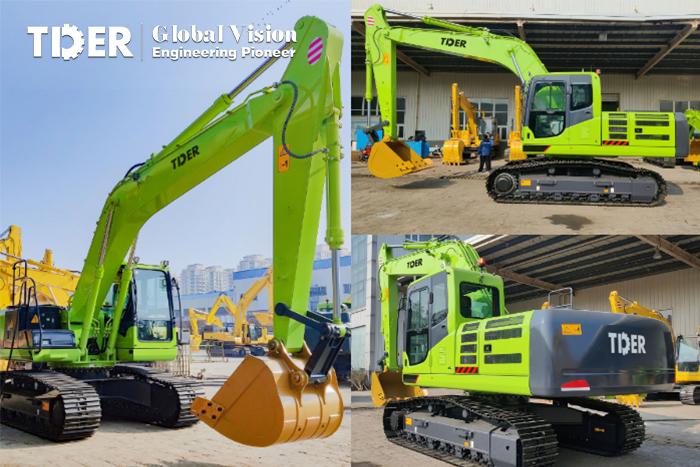
1. Tethered Electric Excavator – TDER TCE210EV
Tethered electric excavators are designed for fixed mining sites with stable power supply, offering continuous operation through external electricity input.
(1) Operating System
In typical mining applications, the model uses a remote-control system combined with cable management technology, supporting safe operation within a 50–100 meter cable range. The machine is also rated IP54, enabling operation in dusty and open-pit mining environments.
(2) Energy & Maintenance Gains
In terms of performance, the model delivers approximately 70% energy cost savings compared with diesel counterparts under similar conditions. Maintenance requirements are also significantly reduced, with motor bearing lubrication required approximately every 2,000 operating hours.
(3) Core Electrical Systems
Key system features include an independent axial-flow cooling motor design, a four-pole leakage protection electrical system, centralized circuit control between upper and lower structures to reduce short-circuit risk, and a soft-start system that reduces inrush current and improves power distribution efficiency.
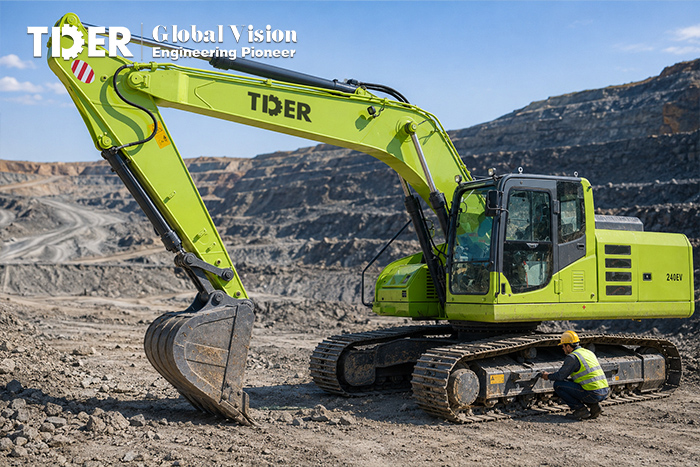
2. Battery Electric Excavator – TDER TCE240EV
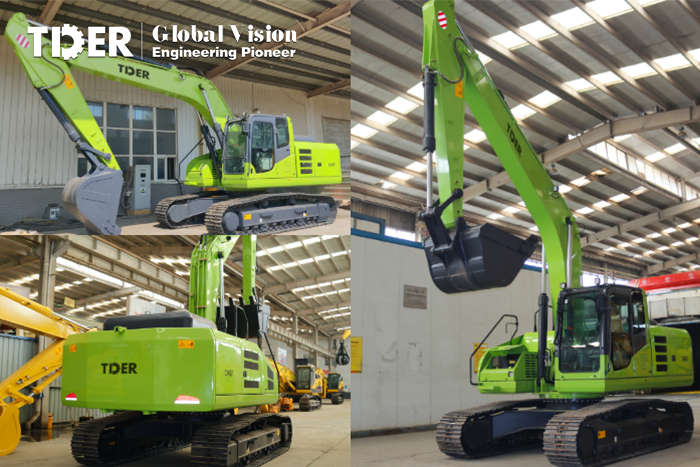
The battery-electric configuration is designed for sites with unstable power supply or frequent relocation requirements, providing greater operational flexibility while maintaining zero-emission advantages.
(1) Battery and Power System
The TCE240EV is equipped with a 423 kWh lithium battery system supplied by CATL, with an operating weight of approximately 24 tons. It integrates Kawasaki hydraulic systems and Doosan travel motors to enhance mobility and operational stability.
(2) Smart Control System
The machine adopts coordinated three-electric system control and intelligent hydraulic pressure regulation, enabling precise and energy-efficient operation. It features an 8-inch LCD display with one-touch operating modes, onboard fault diagnostics, and optional short-range or 5G remote control capability.
(3) Operator Comfort
Ergonomic and thermal management systems further improve operator comfort and system efficiency, including intelligent cooling control, air-suspension seating, and vibration-dampened cabin design.
3. Hybrid Power Excavator
For mining environments with unstable power infrastructure or mixed-duty conditions, TDER hybrid excavators integrate diesel engines with electric drive systems.
This configuration allows operators to switch between power sources depending on load conditions, ensuring operational continuity while optimizing overall energy consumption.
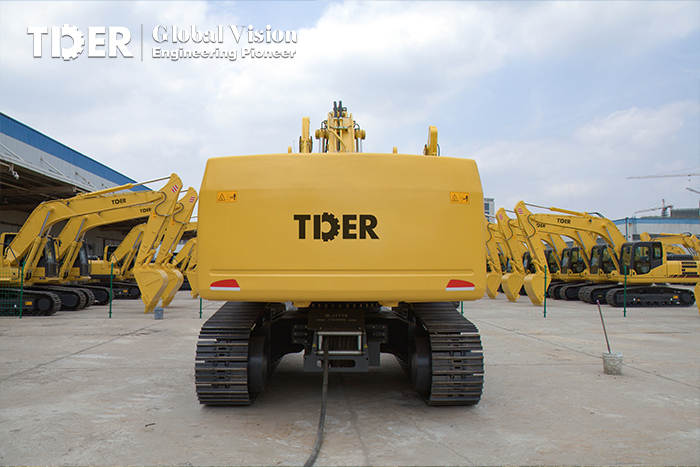
TDER’s electric excavator portfolio now covers a range from 13 tons to 40 tons and can be customized according to different mining conditions, including attachments for excavation, loading, and multi-functional operations.
Looking ahead, TDER will continue to refine its multi-power architecture and modular platform design to address varying global mining conditions, particularly in emerging markets with diverse infrastructure constraints. The goal is to enhance equipment adaptability and support the ongoing electrification of mining machinery worldwide.
 2003- Xiamen TDER Industrial Co., Ltd. All Rights Reserved.