Service Hotline:86-17346269651 /

Recently, at a construction site in South America, a video posted by engineering influencer Miguel Murillo, who has 780,000 followers, has attracted industry attention.
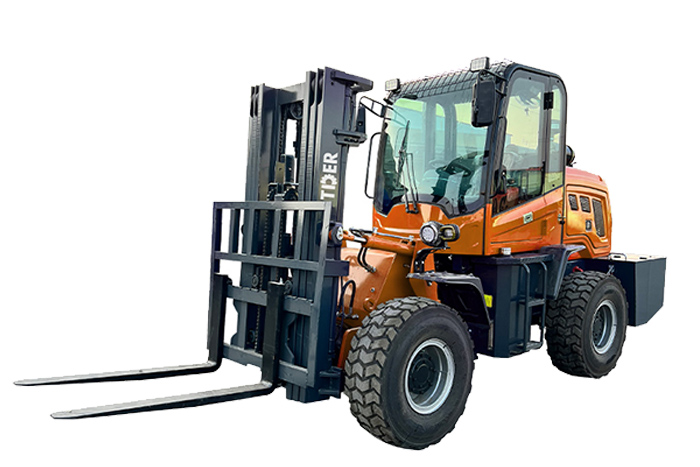
In the video, Miguel conducted an on-site inspection of the construction environment and engaged in in-depth discussions with local technical advisor Daniel Ceballos to evaluate the suitability and operational value of the equipment from a professional perspective. The footage features the TDER 3.5-ton articulated rough terrain forklift, demonstrating its potential in complex conditions and providing highly valuable reference for equipment selection in the local construction industry.
I. Real-World Equipment Selection Logic: Why a Rough Terrain Forklift is the Optimal Choice
The video was recorded in a typical South American construction area with soft ground, muddy sections, unpaved roads, uneven terrain, and temporary construction passages. Based on extensive local experience, technical advisor Daniel Ceballos analyzed the suitability of different forklift types for the site in terms of mobility, stability, and continuous operation reliability.
In these conditions, conventional platform forklifts or standard counterbalanced forklifts are often limited by ground clearance, drive type, and steering design, which can lead to slippage, getting stuck, or restricted turning radius on muddy terrain, making them unsuitable for high-frequency, continuous construction work.
In contrast, rough terrain forklifts are designed from the outset for challenging environments. The TDER rough terrain forklift offers articulated and rigid frame options, supports a four-wheel drive system for stronger power output and enhanced passability, and can be configured with front-wheel or rear-wheel steering. Coupled with higher ground clearance and engineering-grade off-road tires, it maintains stable operation on swampy, rugged, and unpaved surfaces. These structural differences make it uniquely valuable for construction scenarios where standard forklifts cannot perform reliably.
II. Key Performance Advantages: Engineering-Grade Configurations
TDER rough terrain forklifts are equipped with multiple engineering-oriented features to ensure reliability under high-intensity operation:
Robust Structure & Outstanding Load Capacity: Reinforced steel frame with a 30 cm-thick bottom plate, capable of withstanding high-impact, continuous work.
Rear-Wheel Steering & Maneuverability: Small turning radius design enhances stability and safety in confined or complex spaces.
Four-Wheel Drive & Off-Road Capability: Full 4WD with high ground clearance easily tackles muddy, sloped, or rocky terrain.
Reliable Core Cooling Systems: Independently arranged intercooler, water-cooling, and oil-cooling systems ensure stable operation of engine and transmission.
Eco-Friendly & Quiet with Efficient Heat Dissipation: Optimized air filtration and exhaust design reduce noise and enhance heat dissipation, simplifying maintenance.
Versatile Configurations for Flexible Operations: Load capacity options from 1,500 to 6,000 kg, with multiple engines and attachments available to meet diverse operational needs.
Every design element is tailored to real-world construction requirements, not just technical specifications, enabling TDER rough terrain forklifts to operate efficiently and safely under high-frequency, continuous, and complex conditions.
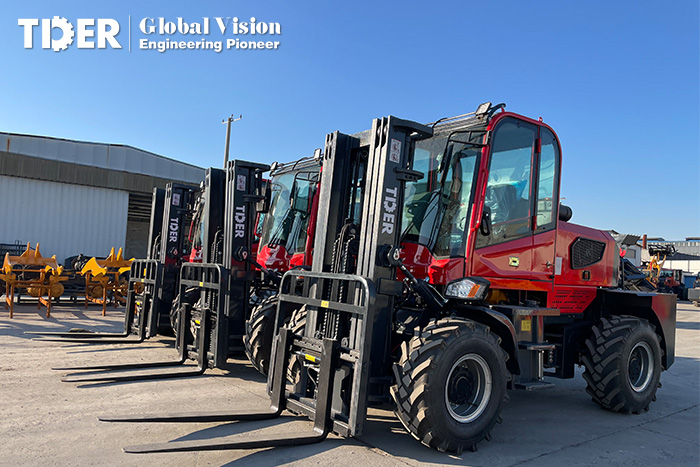
TDER 3.5 Tonne Rear Steering Articulated Rough Terrain Forklift
III. Localized Global Strategy
TDER has long adhered to a “one country, one solution” product development and market strategy. By deeply researching local construction conditions, work habits, and regulations, TDER continuously adapts product structures and configurations to local requirements. The application showcased in the South American video is a tangible example of this approach. By actively collecting user feedback, optimizing product details, and improving service systems, TDER steadily expands its global footprint.
With a focus on worldwide engineering applications, TDER continues to uphold its philosophy of “Global Vision, Engineering Pioneer,” committed to providing customers around the world with high-value and sustainable construction machinery solutions.
 2003- Xiamen TDER Industrial Co., Ltd. All Rights Reserved.