Service Hotline:86-17346269651 /

As global warehousing continues to evolve toward higher density, narrower aisles, and higher operating frequency, enterprises are placing increasing demands on material handling equipment. Beyond improving space utilization, equipment must also ensure operational safety, stability, and long-term cost control. With its distinctive structural design and strong adaptability, the 3 wheel electric forklift is gaining growing attention across the warehousing and logistics sector.
I. Equipment Selection Challenges in Modern Warehousing: Balancing Space and Efficiency
In today’s warehouse environments, more facilities are facing trade-offs between racking height, aisle width, and operating frequency. On one hand, small and medium-sized enterprises aim to increase racking height to fully utilize vertical space; on the other hand, narrow aisles and high-density layouts limit the efficiency of traditional 4-wheel electric forklifts or stackers.
While reach trucks or VNA forklifts deliver strong performance in high-level operations, their higher investment costs and operational complexity often create barriers for many small and mid-sized warehouses. As a result, a new category of equipment has emerged—seeking a balance between flexibility, cost, and spatial adaptability. 3 wheel electric forklifts are filling this critical gap in the market.
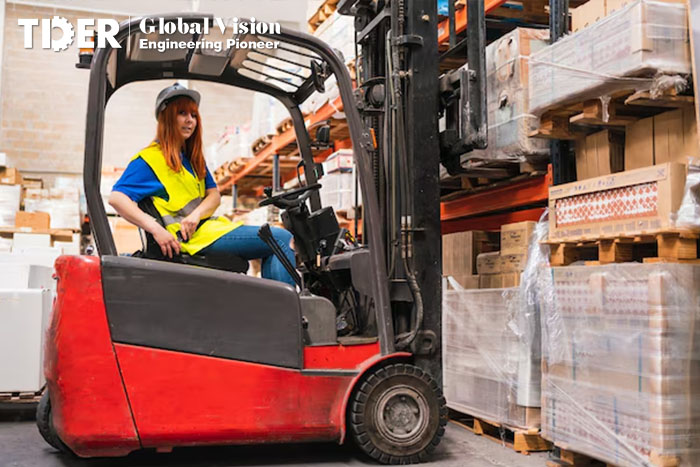
II. 3 Wheel Design: Redefining Narrow-Aisle, High-Frequency Operations
The core advantage of 3 wheel electric forklifts lies in their single rear-wheel steering combined with dual front-wheel support, enabling a smaller turning radius, a more compact chassis, and enhanced maneuverability. This design allows them to operate smoothly in narrow aisles of 1.6–2.0 meters, where traditional 4-wheel forklifts often struggle.
Narrow-aisle adaptability: Improved steering and positioning accuracy for frequent pallet handling
Height coverage: Compatible with mid-to-high racking applications, typically supporting lift heights of 3–5 meters
Low learning curve: Intuitive control logic allows new operators to become productive quickly
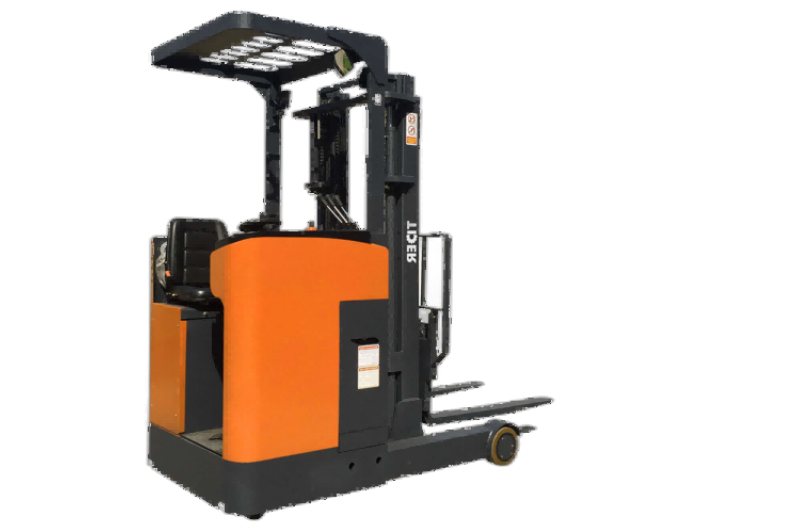
Compared with electric stackers, 3 wheel forklifts can handle higher racking operations; compared with reach trucks or VNA forklifts, they offer lower investment thresholds and simpler operation, while maintaining greater flexibility across diverse warehouse layouts.
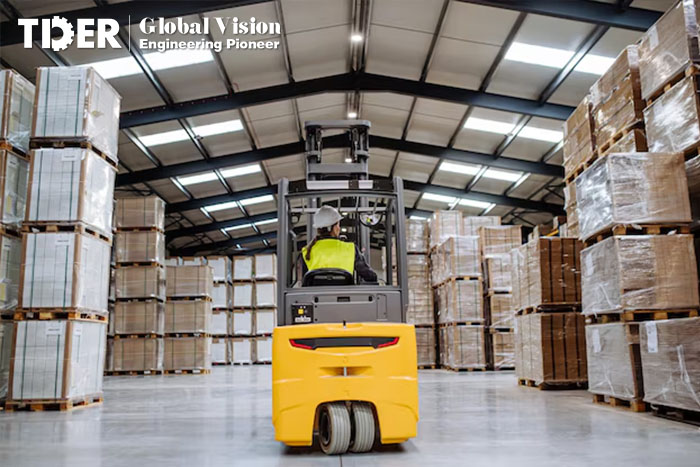
III. Practical Differences from Mainstream Warehouse Equipment and Selection Guidance
Equipment Type | 3-Wheel Forklift | 4-Wheel Forklift | Electric Stackers | Reach Trucks | VNA Forklifts |
High-level work | Mid-to-high level (6–12m) | Mid-to-low level (1.6–5.5m) | Mid-to-low level (1.6–5.5m) | Mid-to-high level (6–12m) | High level (12m and above) |
Narrow Channel Adaptation | 1.6–2m | ≥2.5m | ≥1.8m | ≥2m | ≥2m |
Operational Complexity | Simple | Simple | Simple | Complex | High |
Frequency of Use | High | Medium-Low | Medium-Low | High | High |
Investment Cost | Moderate | Lower | Low | High | High |
Typical Scenarios | Small and medium-sized enterprises, high-density warehouses, frequent picking and placing | Long-distance transportation, medium-to-low height operations | Small warehouses, light-load operations | Medium-to-large warehouses, high-level operations, high-density layouts | Automated, high-density automated storage and retrieval systems (AS/RS) |
Based on comparative analysis, 3 wheel electric forklifts demonstrate clear advantages in mid-to-high-level operations combined with narrow-aisle adaptability and high-frequency handling. They are particularly suitable for small and medium-sized warehouses where operations are frequent and investment efficiency is a key concern, offering a balanced solution between performance capability and cost control.
IV. Real-World Case: Performance of TDER 3 Wheel Electric Forklifts in Practical Warehouse Operations
After a warehouse expansion, a fast-moving consumer goods (FMCG) logistics center in Southeast Asia encountered a typical conflict between space constraints and operational efficiency.
The facility mainly handles full-pallet inbound and outbound operations, with a large number of SKUs and high turnover frequency. Under the existing layout, main aisle widths were approximately 1.7 meters, while racking heights ranged between 4 and 4.5 meters. As order volumes increased, the previously used 4-wheel electric forklifts began to reveal limitations in daily operations: frequent multi-point adjustments were required during turning, adjacent aisles were often occupied, and congestion became common during peak hours, resulting in a noticeable decline in dispatch efficiency.
Without modifying the racking layout, the logistics center introduced TDER 3 wheel electric forklifts as the primary equipment for high-frequency pallet handling and replenishment operations.
According to feedback from the warehouse management team, under the same staffing levels and operating hours:
1.Average effective pallet handling per truck increased by approximately 20–25%;
2.Minor rack contact incidents caused by insufficient turning space were significantly reduced;
3.Average onboarding time for new operators decreased from 5–7 days to around 3 days.
The warehouse manager commented:“We were not aiming for higher specifications at the beginning. What we needed was equipment that works better and causes fewer problems within our existing aisle conditions. The stability and controllability of the 3 wheel forklifts helped resolve bottlenecks we had long overlooked.”
This case illustrates that in narrow-aisle, mid-to-high-frequency operations, steering characteristics and operational consistency often have a more direct impact on overall efficiency than nominal load capacity or lifting height alone.
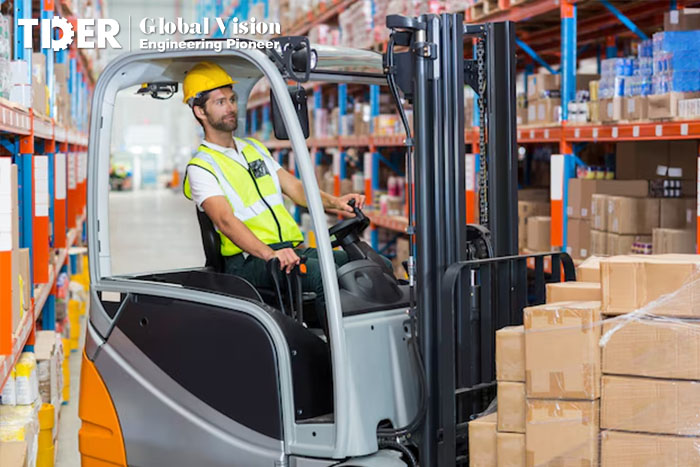
V. Technical Analysis: Key Differences Between TDER 3 Wheel Forklifts and Common Market Alternatives
From an external appearance and basic structure perspective, many 3 wheel electric forklifts on the market look similar. However, under high-frequency and narrow-aisle operating conditions, the real differences typically emerge in control system stability, power response consistency, and long-term operational reliability.
1.Control System Level: Stability Is About “How Consistent,” Not Just “Whether It Exists”
Many 3 wheel forklifts available on the market rely on generic or simplified control systems. While sufficient for light-duty or low-frequency applications, their response consistency tends to decline during continuous high-level pallet handling and frequent steering adjustments.
TDER 3 wheel forklifts are equipped with CURTIS AC control systems, which maintain smooth and predictable output behavior under varying loads, steering angles, and speed transitions.
These differences are not always visible in specification sheets, but in real-world operations they directly affect operator confidence and vehicle predictability—especially critical in narrow-aisle, high-frequency environments where stable feedback helps reduce misoperation risks.
2.Drive System Integration: Not Just “AC,” but System-Level Coordination
Although many 3 wheel forklifts are labeled as AC-driven, there are substantial differences in how well motors, controllers, and transmissions are matched. Some products exhibit overly aggressive responses at low speeds or noticeable performance degradation after prolonged operation.
TDER 3 wheel forklifts adopt a fully integrated AC drive architecture, matched with mature transmission systems. As a result, power delivery and steering feel remain consistent during extended multi-shift operations. This consistency is particularly valuable in peak periods, helping reduce productivity fluctuations caused by equipment behavior changes.
3.Braking and Steering Design: Optimized for Real Warehouse Floor Conditions
In real warehouse environments, ramps, floor joints, and uneven surfaces are common. Some 3 wheel forklifts rely heavily on operator experience due to basic coordination between braking and steering systems.
TDER 3 wheel forklifts feature dual braking systems—electronic automatic braking combined with pedal braking—along with electric power steering, offering more controlled behavior during starts, stops, and low-speed maneuvers.
Rather than adding unnecessary complexity, this design reduces reliance on operator skill levels, enabling consistent and stable use across drivers with varying experience.
4.Energy Consumption and Long-Term Operating Costs: Differences Become Clear Over Time
Short-term testing often shows minimal differences in energy consumption among 3 wheel forklifts. However, under long-term high-frequency usage, disparities in steering load, control logic, and drive efficiency gradually become apparent.
Through electric power steering and system-level energy optimization, TDER 3 wheel forklifts can reduce energy consumption by approximately 20% in real-world operations. In warehouses operating multiple units simultaneously, this translates into meaningful reductions in overall operating costs.
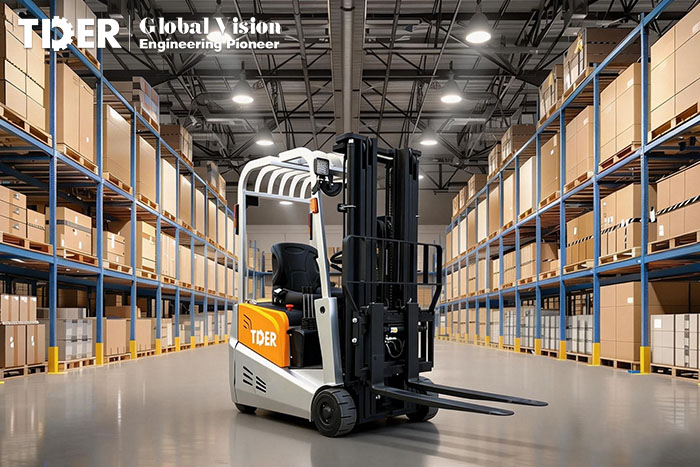
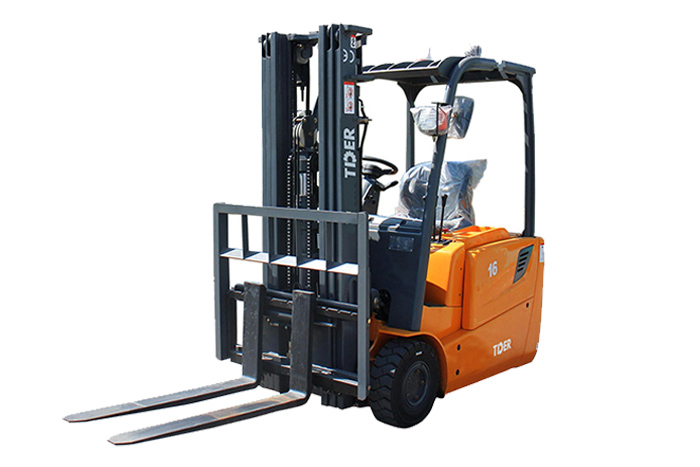
TDER FB15S —— 1.5 Tonne 3 Wheel Electric Forklift Truck
VI. Equipment Selection Recommendations for Different Warehouse Scales
Small and medium-sized warehouses / light-duty high-frequency scenarios:
3 wheel electric forklifts serve as an optimal starting solution—offering agile steering, controlled investment costs, and short training cycles.
Mid-to-high-level dense layouts with higher efficiency demands:
A combination strategy can be considered, using 3 wheel forklifts for 3–5 meter operations, complemented by reach trucks for higher-level requirements.
Large automated high-bay warehouses:
For facilities exceeding 12 meters in height and requiring guided or automated operations, VNA forklifts or AGV systems are recommended, with 3 wheel forklifts deployed as auxiliary equipment at key handling points.
VII. Conclusion and Outlook
As global warehousing continues to shift toward high-density layouts, compact spaces, and high-frequency handling models, equipment requirements are evolving from simply “moving goods” to balancing safety, space efficiency, operational consistency, and long-term value.
With its compact design, strong narrow-aisle adaptability, and high cost-performance ratio, the 3 wheel electric forklift is increasingly becoming a preferred choice for small and medium-sized enterprises.
This trend reflects not only a refinement of warehouse equipment segmentation, but also the ongoing evolution of logistics technologies in response to real operational demands. Buyers who clearly understand application boundaries and long-term performance considerations during the selection stage are better positioned to gain sustainable advantages in an increasingly competitive warehousing landscape.
 2003- Xiamen TDER Industrial Co., Ltd. All Rights Reserved.