Service Hotline:86-17346269651 /

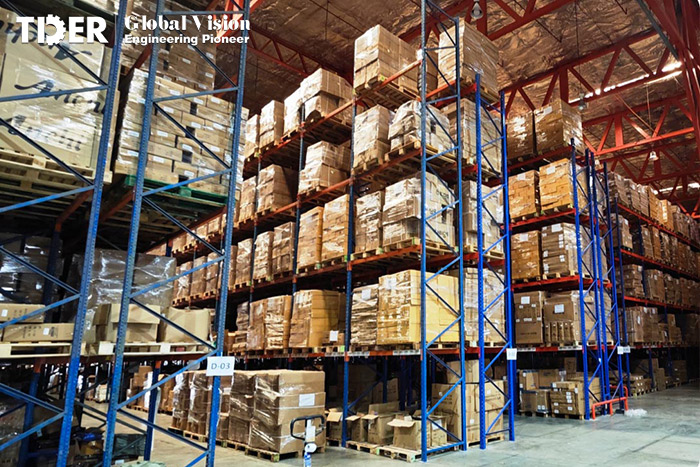
As warehousing, logistics, smart manufacturing and e-commerce distribution continue to evolve, businesses are placing increasing emphasis on storage density, material handling efficiency and warehouse space utilization. For companies operating within limited floor areas and managing a wide range of SKUs, the challenge is to increase usable storage capacity while ensuring that warehouse equipment can perform storage and retrieval tasks safely, reliably and efficiently.
Conventional forklifts require sufficient space for turning and maneuvering. As a result, warehouse rack layouts are often constrained by aisle width, making high-density storage more difficult to achieve. Narrow-aisle storage systems help unlock warehouse capacity by reducing aisle widths and making greater use of vertical space. When paired with three-way pallet stackers, which can handle loads in forward, left and right directions, these systems reduce the need for wide turning movements inside aisles and offer an effective equipment solution for high-density warehousing.
Three-way pallet stackers are generally available in two configurations: man-down and man-up. They differ in operator position, operating method, compatible rack heights and equipment specifications. Choosing the right model requires a comprehensive assessment of warehouse layout, rack height, pallet dimensions and actual operating procedures.
1. What Is a Three-Way Pallet Stacker and How Does It Work in Narrow Aisles?
A three-way pallet stacker is an electric material handling vehicle designed for narrow-aisle warehouse applications. Unlike conventional forklifts, which rely on vehicle steering to change the direction of the forks, a three-way pallet stacker uses a dedicated fork rotation or side-loading mechanism. This allows the forks to handle pallets in three directions: forward, left and right.
During operation, the truck travels straight along the storage aisle. Once it reaches the target rack position, the fork mechanism changes direction to retrieve or deposit the pallet. Because the truck does not need to make large turning movements inside the narrow aisle, the required aisle space can be reduced.
Based on whether the operator is elevated with the lifting platform, three-way pallet stackers are generally divided into two types:
Stand-on Man-Down Three-Way Pallet Stacker: The operator works from the ground-level or stand-on operating position and does not rise to the upper storage level with the forks. The truck's control system is used to perform medium- and high-level stacking operations.
Sit-Down Man-Up Three-Way Pallet Stacker: The operator is elevated together with the lifting platform, allowing direct observation of the load and storage location at height. This configuration supports high-level load handling, inspection and confirmation, making it suitable for high-bay and very-high-bay storage applications.
Both types provide three-way load handling as their core function. However, their different operator positions result in differences in structural design, lifting performance and suitable warehouse applications.
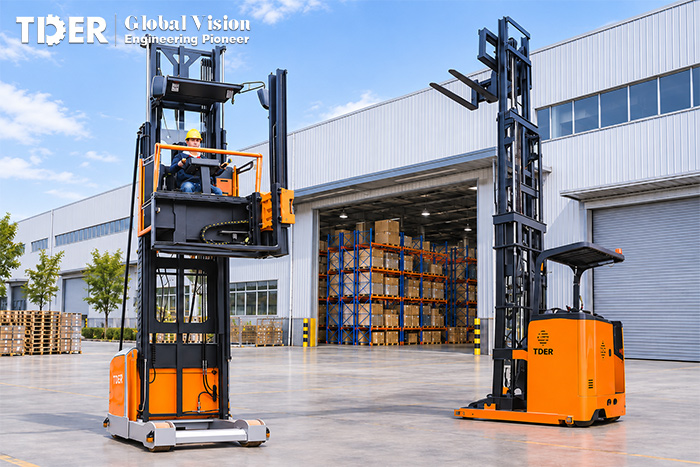
2. What Is the Difference Between Man-Down and Man-Up Three-Way Pallet Stackers?
Man-down and man-up configurations are not simply different equipment grades or levels of specification. They are two distinct equipment solutions designed around different warehouse operating requirements.
Man-Down vs. Man-Up Three-Way Pallet Stackers
Comparison | Man-Down Three-Way Pallet Stacker | Man-Up Three-Way Pallet Stacker |
Operating position | Stand-on operation; the operator does not rise to the upper storage level | Ride-on operation; the operator is elevated with the truck |
High-level operation | Controlled from the truck, with camera assistance | The operator directly observes and verifies the load at height |
Typical storage application | Medium- and high-level storage | High-bay and very-high-bay storage |
TDER rated lift height | 6,000 mm | 10,000–14,500 mm |
Rated load capacity | 1,000–1,600 kg | 1,500–1,600 kg |
Typical applications | Logistics centers, manufacturing warehouses and high-density pallet storage | High-bay warehouses, very-high-bay racking and narrow-aisle storage systems |
Key selection factors | Aisle width, pallet dimensions, operating procedures and lift height | Rack height, elevated operating requirements, floor conditions and guidance systems |
Note: The load capacities and lift heights shown above are published specifications for the corresponding TDER product ranges. They are not standard specifications for all three-way pallet stackers. The rated capacity, load center and maximum lift height must be checked for each specific model.
3. How to Choose Between Man-Down and Man-Up Models Based on Warehouse Requirements
Equipment selection should not be based solely on maximum lift height. The actual warehouse workflow and operating conditions must also be considered. The following factors can help determine which configuration is more suitable.
Select the Equipment Type Based on Rack Height: Rack height is one of the key factors distinguishing the two configurations. For warehouses with medium- or high-level racking, where the required lift height falls within the equipment's rated range and operations mainly involve pallet storage and retrieval, a man-down three-way pallet stacker is worth considering. For warehouses with racks reaching 10 meters or higher, especially where operators need to inspect or verify loads directly at elevated positions, a man-up model should be evaluated. The required lift height must be matched to the actual storage level, load dimensions and clearance needed for fork operation. The nominal rack height alone is not sufficient for selecting a truck.
Choose the Operating Configuration Based on Workflow and Picking Requirements: For warehouses mainly handling full-pallet put-away, retrieval and transfer, with relatively standardized operating procedures, a man-down model may be an appropriate solution. If operations involve elevated load inspection, location verification or more detailed picking tasks that require the operator to reach the storage level, a man-up model may be more suitable. Before purchasing, determine whether the warehouse mainly handles full-pallet movements or requires operators to perform inspection and picking tasks at height. This helps avoid selecting equipment based on specifications alone.
Select the Model Based on Rated Capacity and Load Center: Rated capacity refers to the maximum load a truck is designed to handle under specified operating conditions. Actual load-handling capacity is also affected by the load center, lift height, load dimensions and load center of gravity. The TDER ERF10S–ERF16S man-down range has rated capacities of 1,000–1,600 kg, with load centers ranging from 500 to 600 mm. The man-up ERF15S and ERF16S models have rated capacities of 1,500 kg and 1,600 kg respectively, both with a 600 mm load center. For long loads, loads with an offset center of gravity or oversized pallets, the remaining capacity must be checked even if the load weight is below the rated capacity shown on the nameplate. For high-level operations, always refer to the truck's load chart and obtain confirmation from the manufacturer.
Consider Aisle Width and Floor Conditions When Selecting Equipment: A narrower aisle does not automatically mean a more efficient warehouse. Aisle width must be calculated by considering the truck's overall dimensions, fork rotation and load-handling clearance, pallet length, load overhang, rack structure and required safety clearances. Some man-up three-way pallet stackers use aisle guide rails to support truck guidance. In these applications, floor flatness, floor load-bearing capacity, guide rail positioning and aisle straightness should all be checked during the warehouse planning stage. Before purchasing, it is advisable to provide the equipment supplier with the warehouse floor plan, rack layout, pallet dimensions, maximum load weight and rack height. The supplier can then assess the aisle and operating space against the specifications of the proposed model.
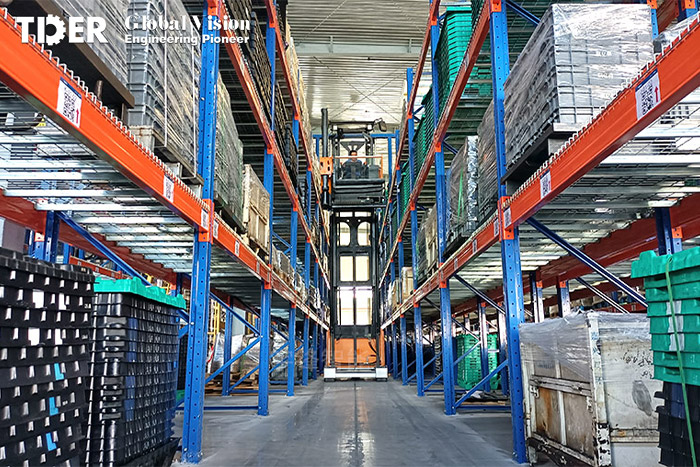
4. What Key Specifications Should You Consider When Selecting a Three-Way Pallet Stacker?
Once the man-down or man-up configuration has been selected, the equipment specifications should be reviewed individually to ensure compatibility with the existing warehouse layout.
Rated Capacity and Load Center: Rated capacity should be selected according to the total weight of the heaviest pallet, including the goods and pallet itself. The load center and the position of the load's center of gravity must also be considered. For oversized loads or loads with a forward-shifted center of gravity, the truck's actual allowable capacity may be lower than its rated capacity. For high-level stacking, always consult the manufacturer's load chart.
Maximum Lift Height and Mast Lowered Height: Maximum lift height determines the highest storage position the truck can reach. Mast lowered height determines whether the truck can pass through warehouse entrances, doorways and other low-clearance areas. For man-up models, additional considerations include overhead guard height, the space required for operator elevation and the overall truck dimensions during elevated operation.
Stacking Aisle Width and Minimum Turning Radius: Stacking aisle width (Ast) is a key specification for narrow-aisle equipment. However, the figure listed in a product specification sheet should not automatically be treated as the minimum aisle width suitable for every warehouse. Actual aisle design must take pallet dimensions, load overhang, fork operating direction, rack clearance and safety allowances into account. The minimum turning radius affects the truck's maneuverability at aisle ends, intersections and main aisles. In addition to the storage aisles between racks, sufficient space must be reserved for entering and exiting aisles and transferring loads.
Floor Flatness and Load-Bearing Capacity: Three-way pallet stackers, particularly high-lift models, require suitable floor conditions. Uneven floors, settlement, cracks or insufficient load-bearing capacity may affect truck stability and high-level stacking accuracy. If guide rails or magnetic navigation systems are used, their installation plans and related floor construction requirements should be considered in advance.
Control System, Steering and Safety Assistance: Narrow-aisle operations leave limited room for maneuvering, making precise control particularly important. The control system, steering system and visibility assistance features should therefore be part of the selection process. EPS electric power steering improves steering convenience in confined aisles. Cameras help operators observe elevated loads and rack positions. Optional features such as magnetic navigation, one-touch height selection and obstacle avoidance can be considered according to the warehouse's automation requirements.
5. TDER Man-Down and Man-Up Three-Way Pallet Stacker Solutions
For narrow-aisle warehousing applications with different racking heights and operational requirements, TDER offers two types of three-way pallet stacker solutions: man-down and man-up models. The product range covers applications from medium- and high-level dense storage to high-bay and very-high-bay warehouse operations.
The TDER ERF10S–ERF16S series consists of stand-on man-down models, designed for medium- and high-level dense storage and narrow-aisle racking applications. These models offer rated load capacities of 1,000–1,600 kg and a published maximum lift height of 6,000 mm.
The TDER ERF15S–ERF16S man-up three-way pallet stackers feature a ride-on operator platform that moves up and down with the operator. This allows operators to access, retrieve and inspect loads directly at height. Designed for high-bay and very-high-bay warehouses, these models offer published lift heights ranging from 10,000 to 14,500 mm.
Both series support three-way fork operation, allowing forward and left- or right-side load handling to suit narrow-aisle racking layouts. Key features include:
Imported H-section steel mast: Provides structural strength for high-level stacking operations.
AC travel drive: Delivers smooth and stable power output.
EPS electric power steering: Improves maneuverability and handling in narrow aisles.
Curtis controller: Ensures stable overall machine control.
High-level camera: Standard equipment on models with mast heights exceeding 4.5 m, helping operators perform elevated operations with better visibility.
Optional intelligent functions: Magnetic navigation, one-touch shelf-height positioning and obstacle avoidance systems
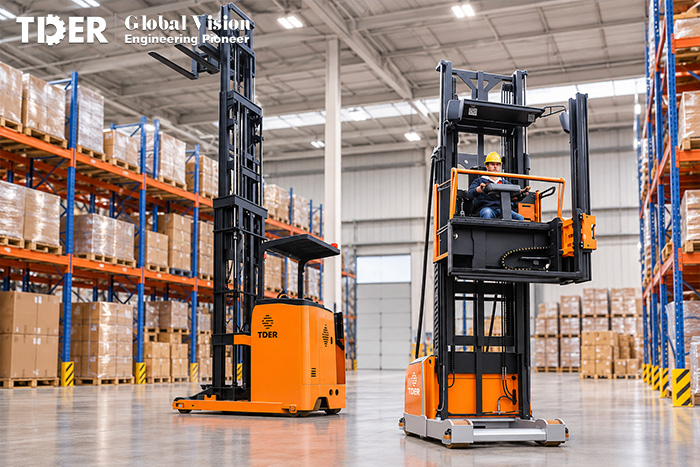
Conclusion: Choose the Right Three-Way Pallet Stacker Based on Your Warehouse Layout
Improving space utilization in a narrow-aisle warehouse is not simply a matter of reducing the distance between racks. It requires the right combination of handling equipment, racking, pallets and operating procedures. Man-down three-way pallet stackers are more suitable for medium- and high-level dense storage, particularly where full-pallet handling is the primary workflow. Man-up three-way pallet stackers are designed for high-bay and very-high-bay racking, especially when operators need to inspect and verify loads directly at elevated positions. Before purchasing, define your rack height, pallet dimensions, maximum load weight, aisle dimensions and floor conditions. Then select the operating configuration and model that best match your actual warehouse requirements.
If you are planning a narrow-aisle warehouse or upgrading the handling equipment in an existing facility, contact the TDER team. Share your warehouse layout and load specifications to receive a three-way pallet stacker recommendation tailored to your application.
 2003- Xiamen TDER Industrial Co., Ltd. All Rights Reserved.