Service Hotline:86-17346269651 /

Against a backdrop of accelerating global urbanization and increasingly scarce land resources, the number of high-rise buildings, glass curtain walls, urban renewal and old-building renovation projects, rail transit and municipal underground-space works keeps rising. "Completing high-elevation lifts within tight spaces" has become a frequent and demanding construction requirement. While traditional tower and truck-mounted cranes deliver high lifting capacity and productivity, they require large access and set-up areas and impose stringent ground bearing-capacity demands — limitations that often render them impractical for indoor, rooftop, elevator-shaft, narrow-alleyway and historic-building-interior applications.
At the same time, tightening construction-safety regulations worldwide and steadily rising labor costs are pushing lifting operations away from manual handling and scaffold-based methods toward mechanized, safer workflows. In this context, the spider crane (also known as a mini crawler crane) — distinguished by its compact structure, transportable in disassembled form, independently adjustable hydraulic outriggers and low ground contact pressure — has emerged as a key lifting solution for space-constrained jobsites. TDER spider cranes now span a complete product line covering 1.5t to 16t load capacity. This article systematically outlines the equipment for customers across structure and principles, technical advantages, typical applications and selection logic.
I. What Is a Spider Crane? — Structural Principles and the Logic of "Four Legs"
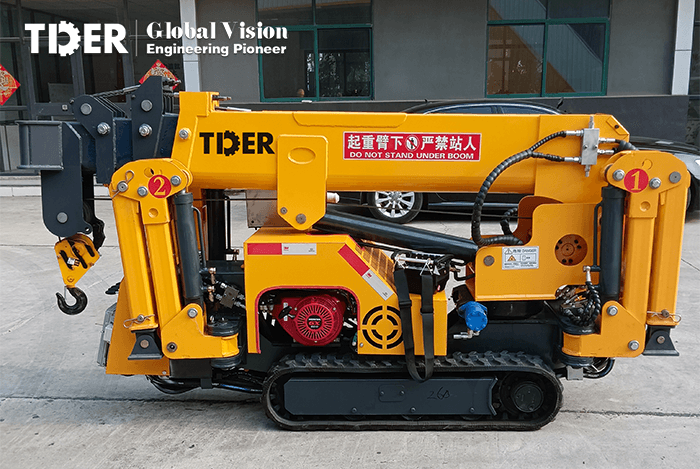
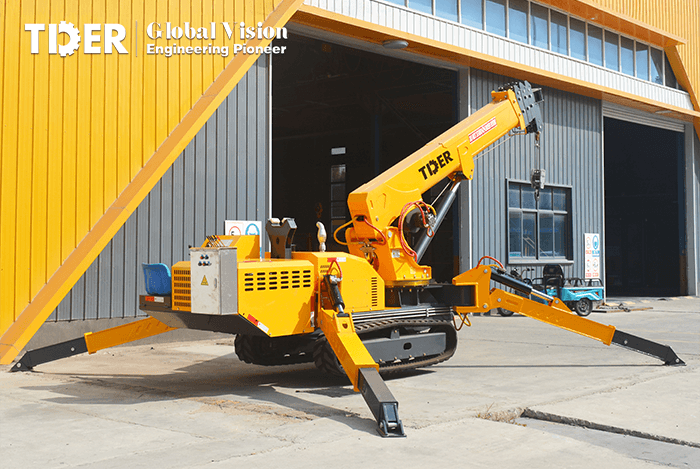
A spider crane is a compact, easily deployed mini crawler crane, so named because its four outriggers resemble a spider when retracted. Its core structure comprises four parts: a rubber-track undercarriage, four independently adjustable hydraulic outriggers, a multi-section telescopic boom and a slewing platform.
The rubber-track undercarriage is the foundation of its ability to "get in and go up." Unlike the wheeled chassis of a truck crane, tracks provide a large contact area and low ground pressure — protecting finished floor tiles and screeds while meeting the load requirements of rooftop work. The four independent hydraulic outriggers are the key to its rock-solid stability: each leg can extend and angle individually, allowing the machine to stay level and steady on steps, slopes, one-sided cantilevers or uneven ground. The multi-section telescopic boom, combined with a 360° slewing platform, delivers a large working radius and lifting height within a minimal footprint.
II. Structural Advantages of Spider Cranes vs. Traditional Cranes
Conventional truck cranes rely on chassis outriggers and a relatively large deployment envelope, demanding substantial site area and ground bearing capacity; tower cranes require rails or tie-in structures, with long erection and dismantling cycles. By combining "tracks + independent outriggers + disassembled transport," the spider crane differentiates itself across several dimensions.
Aspect | Spider crane (mini crawler) | Truck crane | Tower crane |
Access / exit | Disassemblable, transportable via doorways/elevators to floors, roofs | Needs wide access and operating area | Requires rails or tie-ins; long set-up/exit cycles |
Ground requirements | Low track ground pressure; can work on slabs/roofs | Needs flat, solid ground | Needs dedicated foundation |
Outrigger adaptability | Four legs independently adjustable; suits steps and uneven ground | Fixed outrigger spread | Relies on structural tie-ins |
Indoor / shaft work | Whole machine can enter; switchable to electric operation | Hard to enter | Not applicable |
Typical use case | Confined-space, complex jobsites | Open-area heavy lifts | High-rise construction |
It should be noted that spider cranes are not intended to replace tower and truck cranes; rather, they close the capability gap in space-constrained conditions — when equipment "can't get in or set up," the spider crane is often the more realistic choice.
III. Typical Application Scenarios
Based on its structural characteristics, the spider crane is widely used in:
1. Glass curtain wall and unitized-panel installation. Positioned on a roof or within a floor, a spider crane pairs with vacuum-lifter attachments to place glass panels precisely, replacing scaffolding or a tower crane — shortening schedules and reducing breakage risk.
2. Indoor equipment lifting and shaft work. Elevator-machine-room equipment, HVAC units and transformers can be moved via elevator or stairwell to the spider crane's working point for positioning, avoiding the safety hazards of manual handling.
3. Steel structure and roof-space-frame installation. A spider crane can work atop a roof to lift steel beams and space-frame members, supporting areas a tower crane cannot reach.
4. Old-building renovation and historic-structure restoration. Such projects often have restricted access and prohibit damage to existing structure — the spider crane's compact form and low ground pressure fit precisely.
5. Municipal and transit underground space, bridge maintenance and urban rescue. Confined spaces such as metro stations and bridge-underside maintenance, plus emergency rescue on small sites, are all typical spider-crane applications.
IV. The TDER TSC Series: Technical Configuration and Tonnage Selection
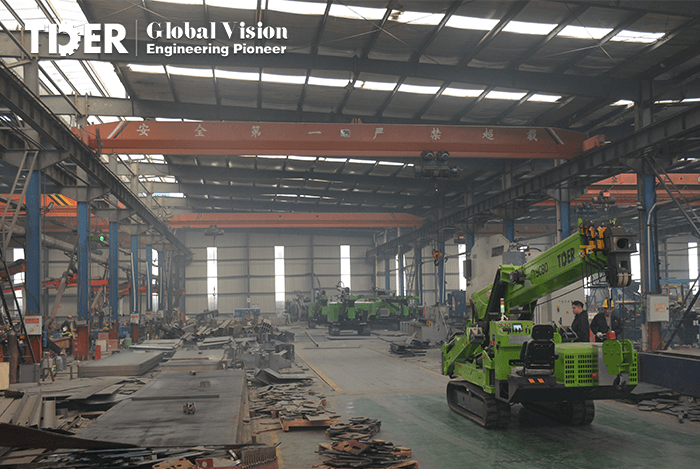
TDER spider cranes form a complete product family from TSC15 through TSC160, with rated loads of 1.5t, 3t, 5t, 8t, 10t, 12t, 14t and 16t and maximum lifting heights from 6.5 m to 25 m — matching varied lifting weights and working-height requirements.
Taking the mid-range TSC50 as an example, its key technical features are: 5 t rated load, 17 m maximum above-ground lifting height, 15 m maximum working radius; a 5-section high-strength manganese-steel telescopic boom with strong torsional rigidity and responsive extension; 300 mm-wide rubber tracks with automatic hydraulic outriggers, balancing stable operation with complex-terrain adaptability; a diesel-plus-electric dual-power system (a 58 kW-class diesel engine, brand customizable), with optional Euro V/EPA emissions systems for environmentally stringent sites; overall dimensions 4.7 × 1.5 × 2.25 m, 6,100 kg operating weight, 25° gradeability and 360° slewing. For configuration expansion, a load-moment limiter, remote-control system, personnel basket and hydraulic fly jib can be optionally installed to suit different operating methods and safety requirements.
The diesel-electric dual-power design merits particular attention: in electric mode, the machine achieves local zero emissions and low noise — ideal for indoor, elevator-shaft and other enclosed or semi-enclosed environments; diesel mode suits outdoor jobsites without stable power supply, giving the equipment stronger environmental adaptability.
V. Selection Guidance and Jobsite Matching
Spider-crane selection is, at its core, a match among lifting weight, working height, transport path and ground conditions. Customers are advised to evaluate the following:
First, determine tonnage by the heaviest component. For glass units and equipment in the 1–5 t class, 1.5–5 t models suit; for medium steelwork and equipment positioning in the 8–12 t class; for larger-span steel beams and bridge maintenance, consider 14–16 t models.
Second, set lifting height by floor height and working radius. Ensure the model's maximum lifting height and working radius meet component-positioning requirements, avoiding lifts that cannot be completed due to insufficient height or reach.
Third, confirm passability against transport-path dimensions. Against doorway and elevator-cabin sizes, verify the passability of the whole machine or its disassembled modules — the prerequisite for whether the equipment "can get in."
Fourth, assess ground conditions against bearing capacity. Against slab/roof load capacity and surface condition, evaluate whether track ground pressure and outrigger layout are acceptable — the key to whether the equipment "can stand steady."
VI. Conclusion
Overall, spider cranes are not about maximizing lifting capacity; their core lies in compactness, flexibility, disassemblable transport and low ground pressure, closing the gap left by traditional cranes in space-constrained conditions. As urban renewal, high-rise and underground-space projects continue to advance, their application scenarios will keep expanding.
TDER advises global customers to comprehensively assess lifting weight, working height, transport path and ground conditions before selection. Through scientific selection and rational configuration, enterprises can both raise the efficiency and safety of lifting in confined spaces and achieve more dependable project delivery in complex jobsites. For detailed configurations and quotations across the TDER spider-crane range, please contact the TDER team for professional selection advice.
References
· Note: Application scenarios for confined-space lifting and glass curtain wall installation are compiled from established mini crawler crane industry practice.
 2003- Xiamen TDER Industrial Co., Ltd. All Rights Reserved.